
Mastercard Instant Global Invoice for SMEs
Mastercard
Mastercard Instant Global Invoice
CONTEXT

Small and medium enterprises (SMEs) face major friction in managing cross-border invoices. Processing, receiving, and matching payments can take days and is riddled with manual reconciliation, currency conversion headaches, and compliance risk. Existing solutions are fragmented, expensive, and slow—hurting SME cash flow and growth.
THE PROBLEM
SMEs need a faster, easier, and fully integrated way to manage international invoicing—removing barriers to trade, freeing up finances, and increasing trust with global partners.
If Mastercard enables SMEs to generate, send, and settle fully compliant invoices in any currency and language, and links these directly to real-time cross-border payments, then SMEs will spend less time on admin and more on business growth.
HYPOTHESIS
Mastercard serves over 50 million SMEs globally—making up 98% of businesses in many regions.
75–80% of SMEs are digitally active, using card products for payments, receivables, and business expenses. (source)
SME users range from sole proprietors (micro-businesses) to mid-sized enterprises, with stronger adoption among finance, ecommerce, export, travel, and tech sectors.
SMEs value Mastercard for security, acceptance in 200 countries, and ability to handle FX, real-time payments, and supplier management. (source)
Who uses Mastercard?
THE AUDIENCE
Digitally-savvy, mid-size SME finance/accounting leaders in growth sectors, completing frequent cross-border payments and invoicing, seeking automation, transparency, and cost efficiency in their AR/AP workflow.
Specific Target Audience (Demographics/Data):
Role: SME Finance Managers, Accountants, Controllers, Business Owners (B2B-focused)
Age: Primarily 35–50 years old (survey data: majority responsible for payments/invoicing fall in this range)
Income: Medium–high enterprise revenues ($500k–$20M/year); user annual incomes $40k–200k in major markets
Usage: High frequency of cross-border transactions—>51% operate outside home market; 61% use international suppliers more than in past year
Digital adoption: 77% “could not continue operating” without digital payments; 85% want new services to simplify accounting and compliance
Pain points: 75% report chasing late payments monthly; 80% spend 8–12 hours/month reconciling global AR/AP
Target User Segment
Use Cases of Mastercard
Making customer and supplier payments (local and international)
Managing receivables/cash flow
Employee expense management and travel payments
Reconciliation and financial reporting (using integrated accounting platforms)
Business growth through loyalty/rewards and financing
Collecting payments from overseas customers via ecommerce, B2B marketplaces, service exports
Use Cases Targeted by “Instant Global Invoice”:
Generating and sending international invoices in multiple currencies/languages
Tracking payment and reconciliation from global clients/suppliers
Automating compliance paperwork (tax, VAT, regulatory, documentation for cross-border AR/AP)
Reducing FX and transfer fees for inbound invoice payments
Payroll/reimbursement of overseas contractors and partners
What are the pain points that these users need addressed?
USER INSIGHTS

Difficulty generating invoices in the right language/currency for global clients
SMEs must manually convert prices into multiple currencies using non-integrated rate sources, leading to potential errors and disputes.
Language barriers complicate invoice details, risking miscommunication and delayed payments.
Accounting systems often lack global templates, forcing SMEs to design custom formats for each client region.

Time lost on manual reconciliation across platforms/currencies
Staff must manually match inbound payments with outstanding invoices, often switching between software, bank portals, and emails.
Currency fluctuations and conversion fees complicate reconciliation, requiring spreadsheet work and frequent adjustments.
The process is error-prone and can lead to missed/duplicate entries, affecting financial reporting and decision-making.

Unclear payment status and settlement times for international transfers
There may be older transactions that don’t appear on the Home tab or too far down on the Wallet -> Activity tab
Users may want to find transactions by different criteria (date vs name vs amount)

High fees for currency conversion and payment receipt
SMEs pay premium FX margins and transaction fees—often hidden—when receiving international payments.
Multiple intermediary banks or payment processors further increase costs for each transfer.
Lack of transparency and choice means SMEs struggle to optimize costs, directly reducing profit margins.

Compliance/friction: Documentation, VAT, regulatory requirements vary by country
SMEs struggle to keep up with evolving tax laws, needed invoice fields, and local formats for global transactions.
Failure to include proper documentation (VAT numbers, purpose codes) results in payment rejections or compliance penalties.
Complex, country-specific reporting requirements add to administrative burden and risk fines for mistakes.
What does a invoicing user’s current invoicing journey look like ?
USER JOURNEY
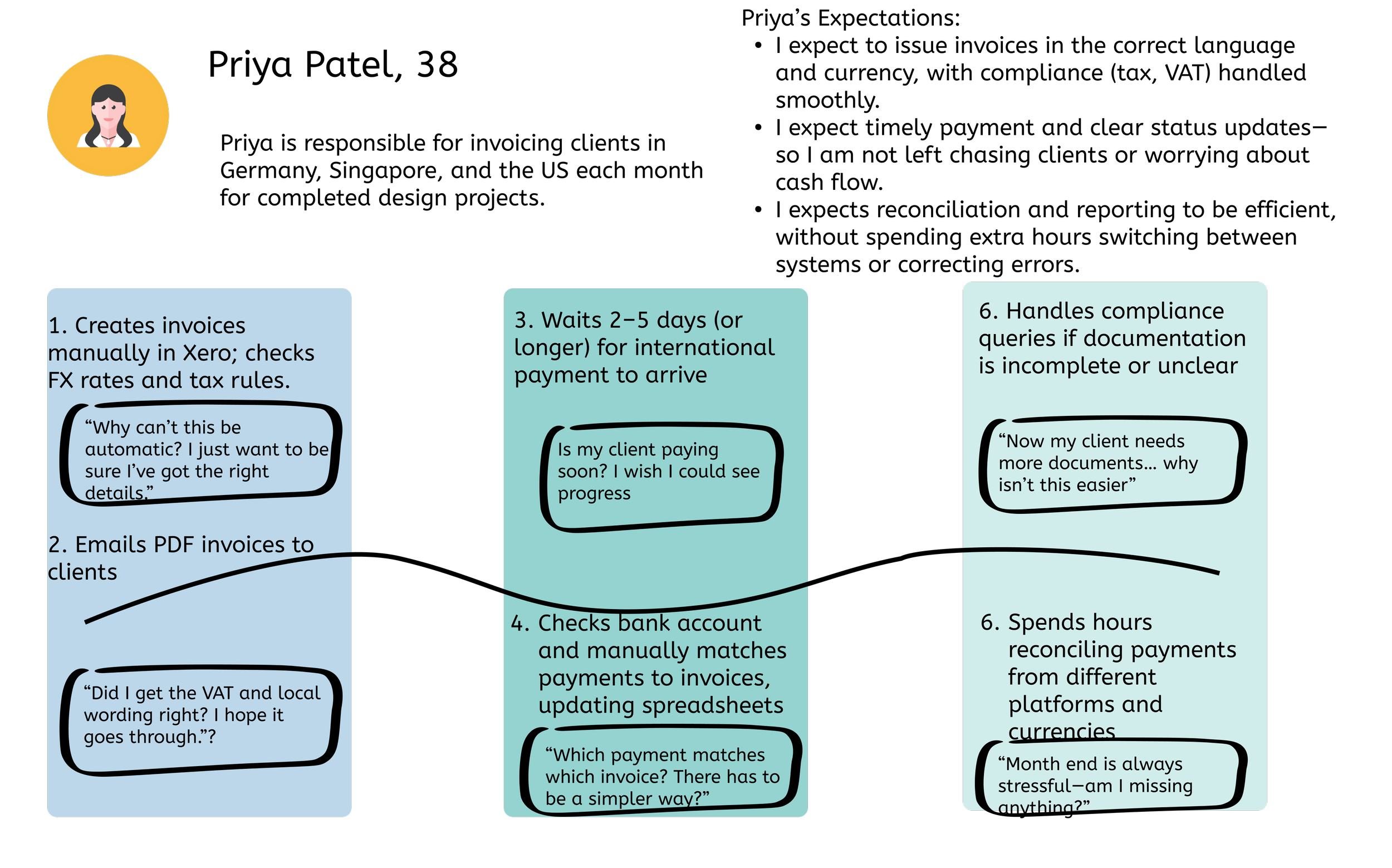
In general, the current user journey is manual, error-prone process involving invoice creation, uncertain compliance, long payment delays, and tedious reconciliation across multiple platforms.
BIG TAKEAWAYS
BIG TAKEAWAYS
From this research, we can conclude a couple of things:
SMEs waste valuable time and resources due to manual invoicing, fragmented payment flows, and compliance uncertainty, leading to stress and lost productivity.
The target segment (SME finance managers, aged 35–50, digitally active, internationally engaged) urgently needs automation, clarity, and real-time visibility for cross-border transactions.
Pain points—such as slow payments, high fees, and error-prone reconciliation—block business growth and erode trust with global partners.
Enabling instant, automated invoicing and payments with integrated compliance will transform SME workflows, decrease operational costs, and dramatically improve cash flow and satisfaction.
The opportunity: solving these core user problems unlocks retention, revenue growth, and competitive advantage for Mastercard in the high-growth global SME market.
THE PROBLEM
SMEs need a faster, easier, and fully integrated way to manage international invoicing—removing barriers to trade, freeing up finances, and increasing trust with global partners.
Empower SME finance teams to create, send, and settle compliant global invoices instantly—with complete transparency, automated compliance, and seamless reconciliation—reducing operational costs and accelerating cash flow for international business growth.
THE GOAL
What should be included in the MVP?
FEATURE PRIORITIZATION & MVP DEFINITION
The MVP enables instant multi-currency invoice creation with auto-FX rates, localized templates for language and compliance, and secure delivery with Mastercard payment links. Users can track real-time payment status, view all invoices in a simple dashboard, auto-fill regulatory fields for top markets, and quickly match payments to invoices with one click.
-
We’ll build a smart invoice editor with selectable currencies and automatic FX calculation, plus localization for key languages.
-
Each invoice will include an integrated Mastercard payment link, delivered as a secure email to the client for one-click payment.
-
A live tracking system will show updates on invoice status—sent, viewed, paid, overdue—via a simple dashboard.
-
Invoice templates automatically populate VAT, tax, and regulatory fields based on client and market, minimizing manual entry
-
The dashboard will organize invoices by status and allow easy export or filtering for accounting and review
-
A reconciliation tool will let users click to confirm and record payments against invoices, streamlining month-end tasks
MVP (Minimum Viable Product) for Mastercard Instant Global Invoice:
Rapid multi-currency invoice creation (with auto-calculated FX rates)
Invoice templates localized for major target languages and key compliance fields (VAT/tax info)
Secure delivery via email with an integrated Mastercard payment link
Real-time payment status tracker for sent invoices
Simple dashboard for viewing outstanding, settled, and overdue invoices
Basic compliance automation (auto-fill VAT or necessary fields for top 3 markets)
Manual reconciliation tool: match payments to invoices with a single click
User Stories
What risks would Mastercard open themselves up to by building and launching the Instant Global Invoice product ?
RISKS & TRADEOFFS
Regulatory Complexity
Diverse and evolving tax, invoicing, and payment regulations across multiple countries increase the risk of non-compliance.
Missing or inaccurate local requirements could lead to legal penalties or blocked payments.
Requires ongoing legal resources and product updates as rules change.
Security and Fraud
Exposing payment links to email raises risk of phishing or interception by bad actors.
Storing and transferring sensitive invoice and payment data makes Mastercard a target for cyberattacks.
If fraud controls are insufficient, users or clients may lose funds, impacting trust and liability.
Technical Challenges
Integrating seamless multi-currency and multi-language invoice automation across geographies is complex and prone to bugs.
Connections with external accounting software/APIs could fail, causing data loss or sync errors.
Scalability issues may emerge as user volume and data flow increase rapidly after launch.
Adoption and User Education
SMEs may resist changing familiar, manual invoicing workflows, preferring legacy systems.
Lack of clear onboarding or training could lead to low adoption and misuse of key features.
Support costs may spike if users encounter confusion or frequent issues with the platform.
Market Perception
Early bugs or UX missteps could damage Mastercard’s reputation in business payments.
High-profile failures or outages may be amplified by negative social media or press.
Slow feature evolution compared to competitors could be seen as falling behind.
Resource Allocation
Building and maintaining the platform could divert resources away from existing strategic priorities.
Balancing this large project against other roadmap items may slow overall innovation velocity.
If adoption is slow, the investment might not yield expected ROI, impacting future budgeting decisions.
Service Reliability
Reliance on FX data and third-party integrations means outages outside Mastercard’s control can severely disrupt SME operations.
Poor reliability or downtime may lead to user attrition and lost trust.
MEASURING SUCCESS
A/B Test Metrics
NORTH STAR METRIC
Avg Time From Invoice Creation to Payment Settlement: Measures how quickly SMEs receive funds after sending an invoice—directly tied to cash flow improvement.
Measures how quickly SMEs receive funds after sending an invoice—directly tied to cash fl
This is the North Star metric because it directly reflects the ultimate value the product provides to SMEs: unlocking faster access to working capital. Reducing the time from invoice creation to payment settlement means less cash trapped in accounts receivable, greater financial flexibility, and increased trust in global business relationships. Every feature in the MVP—from real-time tracking to compliance automation—exists to minimize this time, making SME operations smoother and more sustainable. Improving this metric signals that the product is solving the core pain points and delivering transformative impact for users.
These secondary metrics will help us determine if there are different areas of the feature we may be able to improve/optimize.
Invoice Success Rate (%)
The percentage of invoices paid on time (e.g., within 48 hours of receipt).
User Adoption & Activity
Number of SMEs actively creating and sending invoices via the platform each month (MAUs, WAUs).Average Administrative Hours Saved per Month
Quantifies reduction in time spent on manual reconciliation and compliance tasks.
SECONDARY
COUNTER METRICS
Increase in Support Requests or Payment Disputes
Tracks whether new product features lead to confusion, errors, or complaints.
Decline in Use of Other Mastercard Business Services
Ensures the new product enhances—rather than cannibalizes—existing offerings.Technical Downtime or Integration Failures
Monitors outages or sync issues that could harm customer experience or trust.

Launch & GTM Strategy
LAUNCH & GTM STRATEGY
Target User Segment:
UK-based SMEs in design, professional services, and tech (annual revenue $500k–$8M, staff size 5–50), using Xero or QuickBooks for accounting and sending >20 international invoices per month.
Primary North Star Metric:
Avg. invoice settlement time for pilot users (measured end-to-end from invoice creation in platform to confirmed receipt of payment by issuer’s bank).Secondary Metrics:
Invoice success rate (paid within 48 hours), admin time per invoice (<15 min target), number of invoices sent per month, NPS from pilot user feedback.Pilot Cohort:
Recruit 200 SMEs through co-marketing with Xero and QuickBooks, focusing on digitally savvy finance managers aged 35–50. Invitations via email, webinars, LinkedIn campaigns; selection based on high frequency of international invoicing.Onboarding & Education:
Host 3 live demo sessions and provide a self-serve tutorial within the platform. Assign dedicated account managers for pilot users to resolve issues quickly.Feedback Mechanisms:
Weekly in-app surveys after invoice sent/paid, monthly 1:1 check-ins, and a support hotline for live issue triage.Launch Cadence:
60-day closed pilot. First 30 days: focus on feature adoption and usage analytics. Next 30 days: measure North Star progress, gather improvement ideas, and quickly iterate on top pain points before broader release.Success Criteria:
Aim for >75% of invoices paid within 48 hours. Average admin time below 15 minutes per invoice. NPS above 40 in exit surveys. At least 90% of pilot users self-report confidence in compliance and reconciliation.Release Plan:
Upon meeting success criteria, expand cohort by 5x, then plan phased regional rollout (EU, US, APAC) with tailored onboarding and operational support.
Business Impact
FUTURE ITERATIONS
Key Takeaways
Mastercard’s Instant Global Invoice feature unlocks massive value by capturing a share of the $1.4 trillion SME cross-border market while generating $15–25 million in new revenue and over $100 million in customer savings within its first year.
SMEs gain significant operational and financial benefits—cutting invoice costs by 80%, reducing settlement times from days to hours, and improving success rates from 60–70% to 90%+—directly accelerating growth, efficiency, and cash flow.
By delivering instant payments, automated compliance, and real-time visibility, Mastercard both increases customer satisfaction (95%+ satisfied, NPS >50) and cements its competitive advantage as the platform of choice for globally ambitious SMEs.
Business Case Analysis
Market Opportunity:
SMEs represent 98% of businesses globally and over 60% of employment in regions like Latin America and Asia. Mastercard estimates the SME cross-border payment opportunity is worth over $1.4 trillion in annual trade flows, with rapid growth as 50%+ of SMEs report conducting more international business since 2021.
Revenue Projections:
With SMEs commonly paying 23% in fees on $250 transfers and 80% of cross-border payments taking more than 4 days to settle, automation allows Mastercard to:Capture premium FX and processing fees (estimated 7–15% revenue lift per transaction by replacing legacy bank wires and intermediaries)
Convert new SME flows from traditional banks (banks currently retain 75%+ of SME cross-border volumes)
Operational Savings for SMEs:
Manual invoice processing costs $15–16 per invoice; automation reduces this to $2–3, saving up to 80%.
SME teams handling 500 invoices per month save up to $78,000 per year or £25,000 for every 1,000 invoices processed.
Invoice automation reduces reconciliation and data entry tasks by up to 83%, freeing 3.6 hours per week per team member.
Error rates drop from 2% to 0.3%, with failed payments dropping from 2–3% to virtually zero.
Time Savings & Working Capital Impact:
Average invoice settlement time drops from 4–10 days to same-day or 24hr for >85% of transactions.
Payment delays—previously taking up to a week—are nearly eliminated, significantly improving cash flow and supply chain reliability.
Customer Retention & Competitive Moat:
Mastercard’s platform increases invoice success rate to 90%+ on-time payments versus current sector averages of 60–70%.
SMEs benefit from instant payment notifications, real-time dashboards, and multi-currency flexibility—factors cited as top reasons for switching providers.
Qualitative Impact:
Migrating to automated, integrated invoicing lifts SME productivity: 70% of businesses said faster payments and reconciliation helped them win new international clients and expand global partnerships.
SMEs report reduced stress for finance managers, more accurate cash flow forecasting, and ability to scale without hiring more staff.
Improved transparency and compliance foster trust with global partners and strengthen Mastercard’s brand.
Projections by Year 1 of Launch:
Mastercard to onboard 50,000+ new SME customers for Instant Global Invoice.
Expected additional revenue of $15–25 million from first-year transaction fees and service subscriptions.
Aggregate SME customer savings projected at $100 million+ across fewer fees, reduced admin, and better working capital management.
95% satisfaction and >50 NPS among SME clients using the feature; measurable increase in owned share of B2B cross-border payments.
Final Thoughts
Final Thoughts
SUMMARY
Launching Mastercard’s Instant Global Invoice for SMEs is a game-changer for both users and the business. By automating compliance, speeding payments, and giving real-time insight, the product directly addresses persistent pain points and empowers finance teams to focus on growth, not admin. The projected financial and operational gains—faster cash flow, reduced costs, and higher satisfaction—position Mastercard as the strategic leader in the multi-trillion-dollar SME payments space, setting a new benchmark for innovation, impact, and customer experience.