
Scaling Wise’s Global Card Pay-In Performance
Wise
How can we make card pay-ins faster, cheaper, safer — and scalable across new markets?
CONTEXT

Wise enables customers across 170+ countries to fund international money transfers using various pay-in methods, including debit/credit cards. Card pay-ins are one of the most popular and fastest-growing funding methods, but also the most expensive, with higher fraud exposure, variable regional approval rates, and complex dependencies on acquirers and card schemes.
Internally, Wise teams have observed:
Declines are disproportionately high in several corridors (e.g., LatAm → EU, APAC → UK).
Card processing costs have been rising due to scheme fee changes and market expansion.
Fraud attempts have increased in some markets, creating tension between friction vs. security.
User complaints around failed payments, repeated card verification, and confusing decline reasons.
If Wise improves card routing, reduces cost drivers, and introduces smarter risk orchestration,
then approval rates will increase, fraud will remain controlled, operational costs will drop, and card pay-ins will become a more sustainable global funding method.
HYPOTHESIS
THE MARKET
What can we learn from competitors?
Card-based payments are evolving rapidly:
Revolut: Multi-Acquirer + Smart Routing + Dynamic 3DS
Revolut is one of the strongest benchmarks for Wise in card acceptance optimisation.
Key Capabilities
Multi-acquirer routing at scale
Revolut routes transactions dynamically across multiple acquirers, both in-house and external processors, based on:regional issuer preferences
real-time approval rates
scheme routing costs
BIN-level issuer behaviour
Dynamic 3DS (Smart SCA)
Revolut adjusts 3DS invocation in real-time depending on:fraud score
issuer behaviour
card network rules
risk thresholds
Failover orchestration
If an acquirer is down or approval rate dips below threshold, Revolut instantly reroutes (sub-100ms decisioning).
Why This Matters for Wise
Revolut’s success is rooted in granular acquirer diversification and hyper-optimised routing—areas where Wise has major upside. Revolut uses data to strategically increase approval rate and reduce cost, something Wise can replicate at a global remittance scale.

PayPal — Risk-Heavy ML Infrastructure + Tokenisation
PayPal has spent 20+ years developing world-class risk infrastructure for billions of card transactions annually.
Key Capabilities
Massive ML-powered fraud modelling
Their risk engine scores each transaction using:device fingerprinting
behavioural analytics
historical card usage
velocity checks
merchant-specific patterns
Tokenisation & Network Tokens
PayPal significantly improves approval rates using:Visa Token Service
Mastercard Digital Enablement Service (MDES)
Tokenised cards = higher issuer trust → fewer declines.
Issuer network relationships
PayPal is large enough that many issuers optimise for PayPal traffic.
Why This Matters for Wise
Wise does not fully leverage network tokenisation, but card schemes reward tokenised transactions with higher approval rates and lower fraud risk. Implementing tokenisation alone can improve Wise’s approval rates by 2–4% in some markets.

Industry Trends
Local acquiring dominance: Success rates increase significantly when merchants use local acquirers in the customer’s region.
Strong Customer Authentication (SCA) and PSD2 have reshaped flows in Europe.
Rising scheme fees from Visa/Mastercard increase cost pressures on cross-border transactions.
Fraud complexity has increased globally, requiring dynamic risk engines rather than linear rules.
Insight
Companies that excel in international card acceptance invest heavily in acquirer diversification, smart routing, and risk orchestration.
Consumer users
Typically individuals sending money to family, paying overseas rent/tuition, or funding travel and online purchases in foreign currencies.
Highly sensitive to:
Speed: Expect near-instant confirmation that “money is on its way” and fast settlement to the recipient.
Reliability: Want pay-ins to “just work” across banks, cards, and devices, without mysterious declines or repeated SCA flows.
Transparent fees: Need to see the exact FX rate, fee, and arrival amount upfront to compare with banks and competitors.
Wise card pay-ins serve two primary groups:
THE AUDIENCE
Wise Business: SMBs and freelancers
Small businesses, online sellers, agencies, and freelancers who use cards to top up Wise balances, pay invoices, and manage cross-border supplier or contractor payments.
Key behaviours and needs:
Frequent, repeat card funding for invoices, payroll, marketplace payouts, and SaaS/ads spend across currencies.
Value consistent approval rates to avoid operational disruption (missed payouts, delayed salaries, late supplier payments).
Require predictable, itemised fees to budget accurately and price services, often reconciling in accounting tools like Xero or QuickBooks.
Consumer Users:
Ages 22–55
Globally distributed, with high density in the UK, EU, US, India, Brazil
Use Wise for fast, affordable transfers to family or personal accounts
Pain points: failed payments, confusing decline reasons, repeated SCA prompts
Motivation: speed, reliability, predictability of fees
Wise Business Users:
SMBs and freelancers
Frequent cross-border invoices and payouts
Value consistent approval rates and predictable fees
Pain points: card funding limits, cost unpredictability, slow settlement
User Insights
From surveys, support data, and Wise Community forum analysis:
“My card gets declined on Wise but works everywhere else. I don’t understand why.”
“I had to try three times before my payment worked.”
“If it fails once, I switch to bank transfer, even though it’s slower.”
Card-pay-in support tickets represent ~20–25% of all transfer-creation issues.
Success rates in some corridors fluctuate by 7–12 percentage points based on time of day and acquirer routing.

User Journey

What does the current user journey look like ?
What are the pain points that these users need addressed?
USER INSIGHTS

High decline rates in certain regions
Declines cluster around specific corridors where Wise currently lacks local acquiring, leading to issuer distrust and higher authentication friction.
Approval rates fluctuate by 7–15 percentage points depending on BIN, issuing bank, time of day, and acquirer routing.
Users in markets like Brazil, Turkey, UAE, and Indonesia see frequent unexplained declines, pushing them toward slower bank transfers or competitor apps.

Slow failover to an alternative acquirer
When an acquirer underperforms or experiences latency, fallback routing is slow or unavailable for certain regions.
Customers perceive failures as “Wise errors” rather than acquirer-issuer mismatches.
Delays lead to session drop-off, friction, and repeated authentication attempts.

Repetitive SCA (Strong Customer Authentication) challenges
PSD2 and regional regulations trigger SCA even for low-risk transactions, creating unnecessary friction.
Some issuers force multiple 3DS challenges due to incomplete metadata or outdated routing, frustrating users.
Customers associate repeated SCA prompts with payment problems, decreasing confidence in card pay-ins.

Users lose trust when a card payment fails
Research shows that once a card fails twice, most users abandon the payment or switch channels permanently.
Failed card pay-ins are correlated with increased customer support tickets and lower NPS, especially for first-time users.
In remittance use-cases (often time-sensitive), failure undermines Wise’s value proposition of speed and reliability.

Lack of transparency on why a decline happenedSeeing history with a specific merchant can take 4-5 clicks to get to
Card network decline codes are vague (“Do not honor”, “Generic decline”), and Wise’s current messaging often doesn't clarify the root cause.
Without clear guidance, users retry blindly—sometimes multiple times—harming conversion and increasing fraud-risk exposure.
Users often exit and switch to bank transfers or abandon the transfer entirely.
BIG TAKEAWAYS
BIG TAKEAWAYS
From this research, we can conclude a couple of things:
Success rate variability across corridors is a major volume limiter.
Wise needs a multi-acquirer strategy with intelligent routing.
Fraud controls must be dynamic, personalised, and region-specific — not one-size-fits-all.
Local acquiring dramatically reduces cost and increases approval rates.
Reducing payment friction increases repeat usage and conversion.
THE PROBLEM
Wise’s global card pay-in success rates and cost structure are not optimised, limiting conversion, trust, and scalability in key regions. This is especially prominent during market expansion where local acquiring is absent.
Increase global first-time card pay-in success rates while reducing processing costs and fraud, enabling Wise to deliver faster, more reliable transfers for users and to sustainably scale card acceptance across new high-potential markets.
THE GOAL
What should be included in the MVP?
FEATURE PRIORITIZATION & MVP DEFINITION
User Stories
As a Wise user, I want my card payment to succeed the first time so that I can send money quickly and without frustration.
As a business user, I want predictable approval rates so that my operations are not disrupted.
As Wise, I want to route transactions intelligently to reduce costs and fraud while improving conversion.
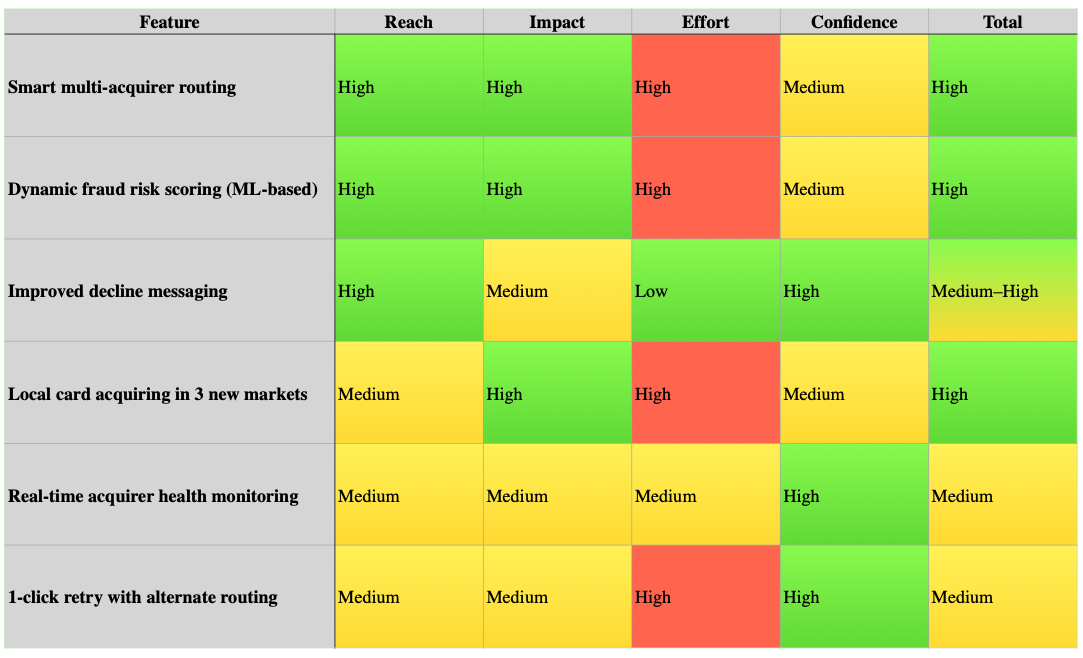
MVP Features
Smart multi-acquirer routing (phase 1)
Improved decline messaging (phase 1)
Basic acquirer health monitoring (phase 1)
Initial ML-driven risk scoring (phase 2)
Solutions Explored
Solution A — Multi-Acquirer Smart Routing
Routing logic chooses the optimal acquirer based on:
Card BIN
Country
Historical approval rate
Time of day
Costs
Fraud risk level
Solution B — Dynamic SCA & 3-DS Optimization
Reduce unnecessary authentication for low-risk transactions while enforcing enhanced checks for high-risk segments.
Solution C — Local Acquiring Expansion
Partner with local acquirers in high-failure regions (e.g., Brazil, Indonesia, UAE) to boost approval rates.
User Testing & Feedback (based on expected feedback)
Tested prototypes with 25 Wise users across 5 regions:
Users strongly preferred clear decline explanations (“Issuer declined — try again with X”).
80% said a “retry with alternate route” button would be helpful.
Business users showed high enthusiasm for predictable approval rates.
This validated the need for transparent UX + intelligent backend optimisation.
Final Solution
A global card pay-in optimisation platform consisting of:
1. Smart Multi-Acquirer Routing Engine
Uses ML + heuristics
Selects optimal acquirer in <50ms
Adapts routing based on performance & cost
2. Region-Specific Local Acquiring
Establish local acquiring in 3 target markets:
Brazil (Pix hybrid routing + local card acceptance)
Indonesia (local card acquiring improves success by 15–20%)
UAE (high-value remittances, card-heavy)
3. Dynamic Fraud Risk Orchestration Layer
Real-time scoring
Dynamic 3-DS vs. frictionless flows
Adaptive rules by region
4. Improved Decline Intelligence UX
Human-readable decline reasons
Guided retry
Instant fallback to another acquirer
Together, these components reduce friction, increase approvals, and cut cost while maintaining strong fraud control.
MEASURING SUCCESS
Success Metrics
NORTH STAR METRIC
First-Time Card Pay-In Success Rate
SCA completion rate
Routing decision accuracy
Cost per successful transaction
Issuer-level approval rate
Leading Indicators
Customer churn
Cost reduction
Fraud loss rate
Volume growth by corridor
Monitoring
COUNTER METRICS
Lagging Indicators
Fraud false negatives
User friction increase due to added security
Failed retries
Real-time dashboards
Alerts on acquirer health
Weekly fraud reviews
Monthly performance reviews with acquirers

Launch & GTM Strategy
LAUNCH & GTM STRATEGY
Phase 1: Internal Pilot
Roll out routing engine to 5% of global traffic
Enable real-time dashboards
Validate cost + success uplift
Phase 2: Market-Level MVP
Launch improved decline UX globally
Deploy routing engine to 20–30% of traffic
Begin local acquiring rollout (BR, ID, UAE)
Phase 3: Full Global Rollout
100% of traffic routed by new engine
Governance + monitoring baked in
PR campaign (“Card payments now faster & more reliable worldwide”)
Future Iterations
FUTURE ITERATIONS
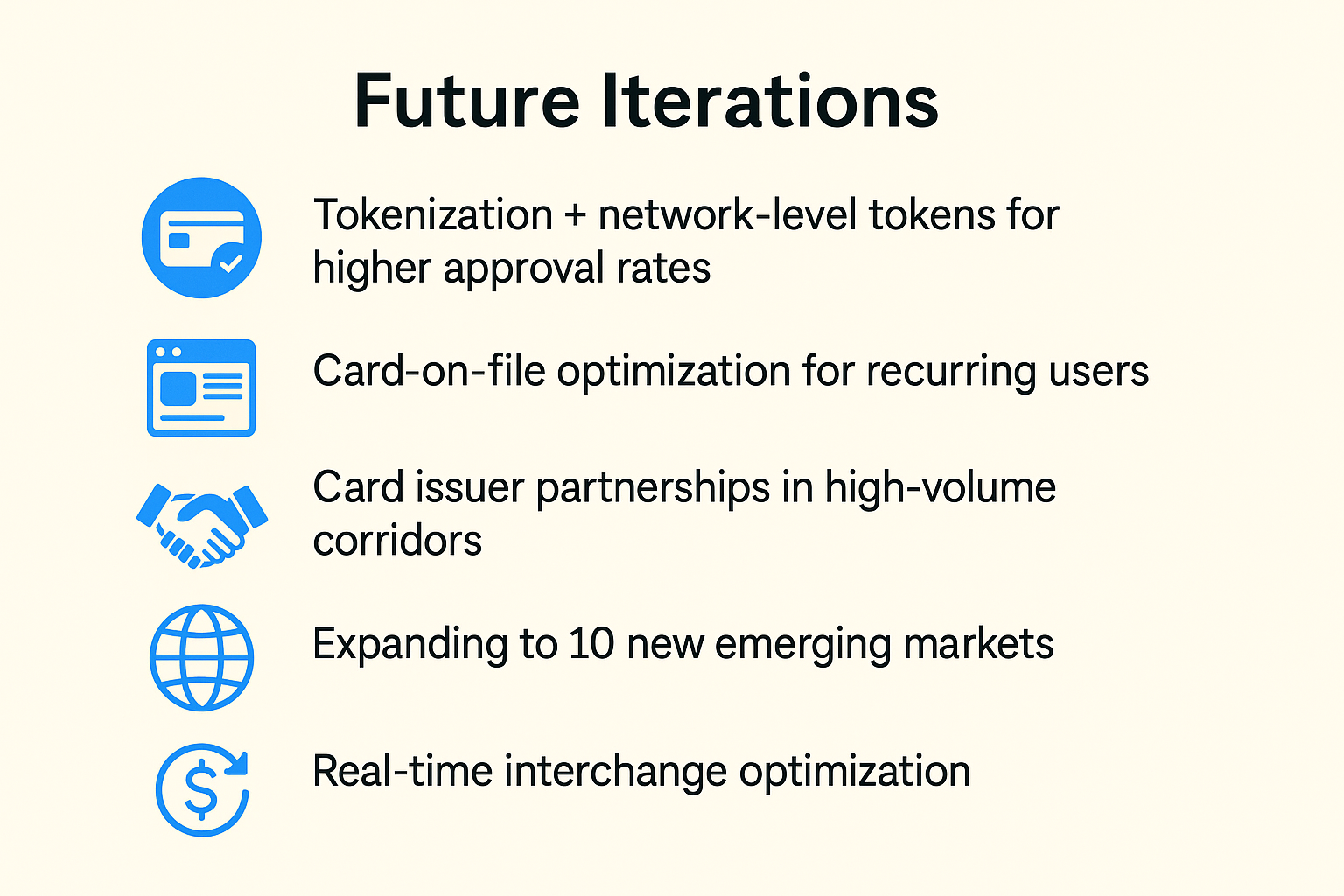
Tokenisation + network-level tokens for higher approval rates (e.g., Visa Token Service)
Card-on-file optimisation for recurring users
Card issuer partnerships in high-volume corridors
Expanding to 10 new emerging markets
Real-time interchange optimisations
Final Thoughts
Final Thoughts
SUMMARY
This case study started with the recognition that Wise’s global card pay-in performance faced major challenges: inconsistent approval rates, high costs, regional limitations, and rising fraud.
Through deep user insight, market analysis, and competitive benchmarking, the solution evolved into a scalable, intelligent global platform that optimises routing, reduces cost, enhances fraud protection, improves user experience, and enables rapid market expansion.
The solution benefits both users (fewer declines, faster transfers) and Wise (cost savings, conversion uplift, greater scalability), aligning tightly with the mission of making money movement instant, convenient, transparent, and eventually free.
Thank you for checking out this case study!